At a glance
- The brief
- Make a garden passage and its connection to the deck feel deliberate.
- The site
- A compact route bounded by established shaped planting and a fence.
- The work
- Stamped-concrete walkway and courtyard integrated with the deck and garden edges.
- The palette
- Stamped concrete with a stone-like pattern, deck boards, boulders, and clipped planting.
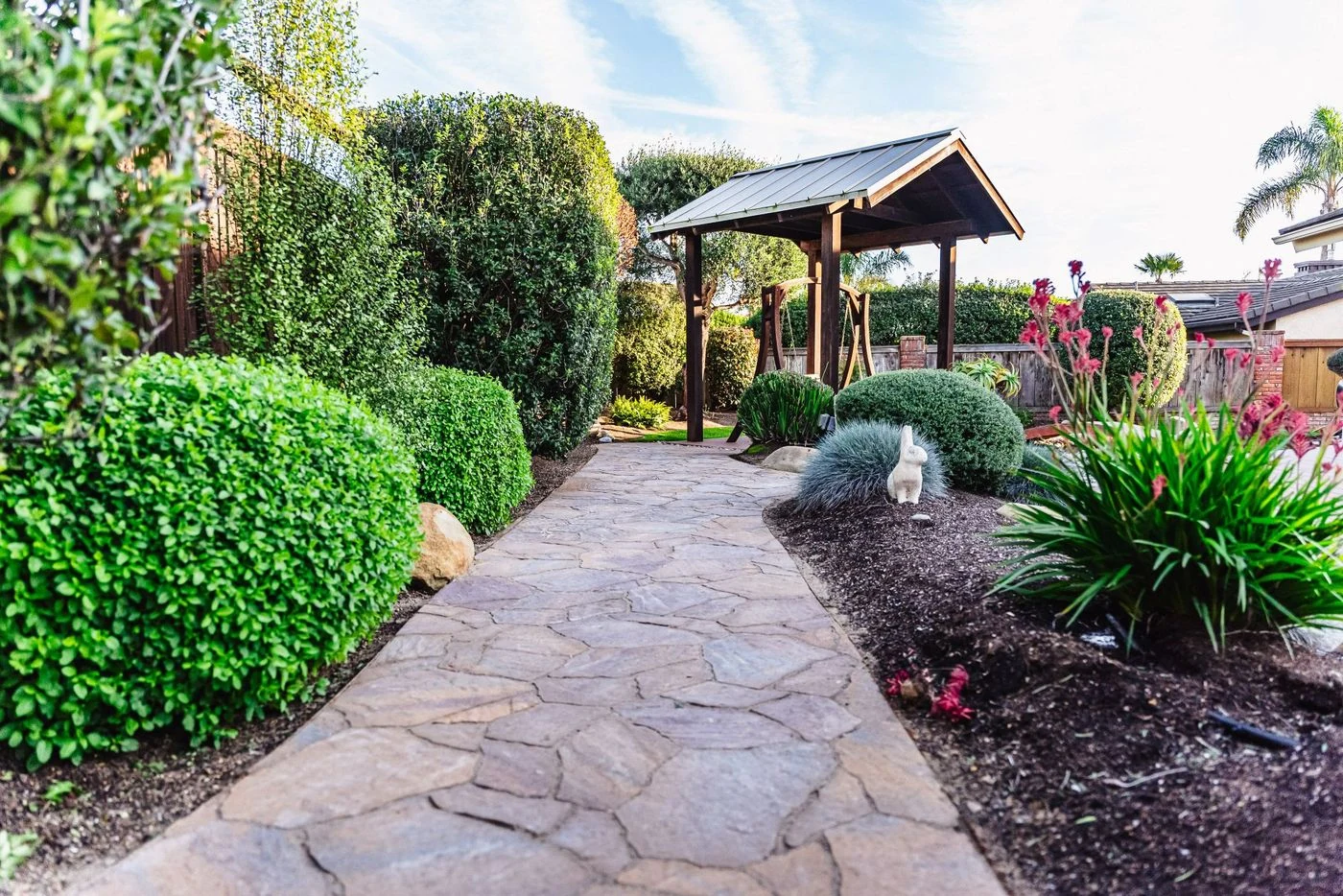
A passage can be more than the space left between a deck and a fence. At this Shell Beach property, a curved route moves between clipped green forms, opening into a small courtyard before continuing toward a garden structure. Pacific Outdoor Living's Natural Stonescape project gives a useful everyday journey the attention usually reserved for a sitting area.
Let the route make a small room
The path is not the same width from end to end. In the photographs, it broadens around a clipped tree and narrows beside deeper planting. That alternation gives the walk a place to pause without filling it with furniture.
The before photograph is instructive. Established shaped plants already give the passage a strong character. The finished surface makes their relationship to the route more apparent. This is a reason to study an existing garden carefully before assuming that a renovation needs to replace everything in it.
A homeowner can begin by marking the essential journey from door to gate. Then look for one spot where the route can widen without sacrificing the planting that gives it enclosure. The widening needs a purpose: a comfortable turn, a view back toward the house, or room to wait while someone opens a gate.
Look closely at the material
Despite the project's name, the firm identifies the walking surface as stamped concrete. Its irregular pattern suggests separate stones, but it should not be mistaken for individually laid flagstone. The distinction matters when discussing joints, future repairs, surface treatments, and a matching extension.
The close-up photograph is more useful for that conversation than the distant view. It shows the relief of the pattern and its meeting with a planted edge. Ask to see a proposed finish at that same distance, then step back far enough to judge the overall color and repetition.
At the deck, a different material announces a change in use. The parallel boards contrast with the irregular path pattern. The junction gives each surface a clear role rather than attempting to make the entire garden look like one material.
Keep the planting legible
Rounded shrubs, taller clipped forms, and lower tufts occupy different heights. Their repeated shapes make the passage feel composed even where neighboring roofs remain visible. The fence supplies a continuous background, while gaps near the trunks let light through.
That look carries an ongoing commitment to clipping. Borrowing the arrangement does not require borrowing the same maintenance routine: a looser garden might repeat naturally rounded plants suited to the site. The important decision is where a plant may spread and where the walking line needs to remain open.
Save the useful view
The contrast is clearest where the straight deck boards meet the stamped-concrete courtyard. One surface leads toward the house; the other bends around the planting. The small change in width beside the clipped tree turns a passage into somewhere worth pausing.
At home
Save an overall view of the route and a close view of where it meets the house. Preserve useful existing planting, and identify the actual paving material before discussing its care or repair.