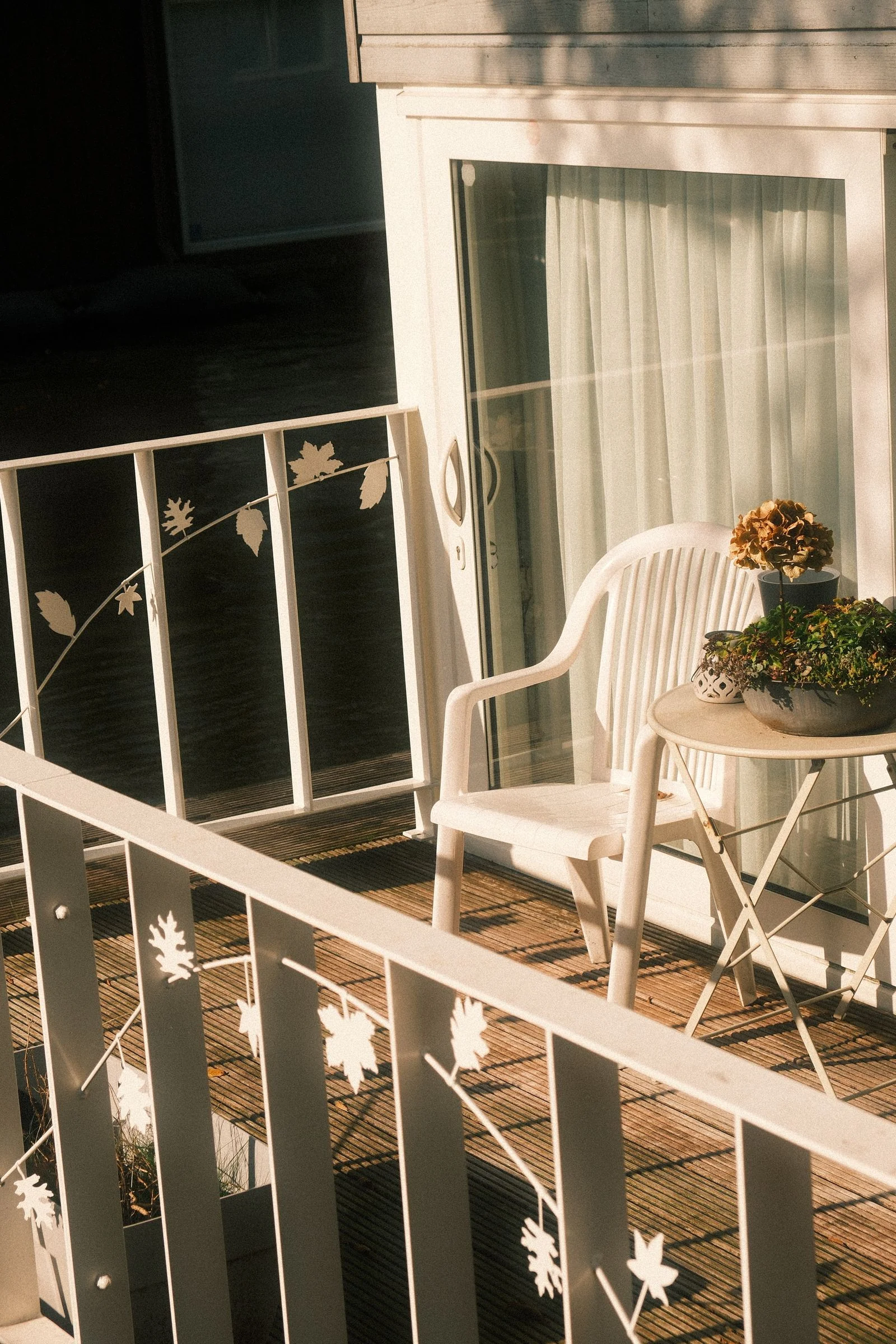
Pots accumulate one at a time. Eventually the patio can hold an assortment of attractive plants without a clear place for any of them. Editing that collection starts with the view, but a lasting arrangement also has to accommodate roots, drainage, watering, and the person doing the work.
Move the empty containers into position before buying plants. Sit at the table and open the doors. A group that looks generous from the kitchen may leave too little room for a chair to move, while a single larger container can give a neglected corner a clearer purpose.
Give each pot a job
Choose a main role for the group: frame an entrance, soften a blank wall, bring herbs near the kitchen, or create a view from a chair. Then vary height or silhouette while repeating something recognizable, such as the finish or a foliage color. You do not need a different plant in every pot.
Judge the future plants as well as the empty vessels. Check mature spread, not only the height printed on a label. A trailing plant can cover a path edge, and a broad shrub can occupy the airspace needed to pull out a chair. Mark that eventual outline with something easily moved and walk around it.
Plan the root space
University of Maryland Extension advises matching a container to both the plant's top growth and its roots, considering depth as well as volume. The largest-looking pot is not necessarily the one with the most usable growing space: an insert or false base may make a tall vessel much shallower inside.
Measure the interior before ordering mix. For a simple rectangular planter with an internal growing space of 24 by 12 by 12 inches, the gross volume is 2 cubic feet: multiply the dimensions in inches and divide by 1,728. That is a worked example, not a planting prescription. Allow for the plant's root ball, watering headspace, and any manufacturer-specified insert. A tapered or curved pot needs its actual capacity checked rather than this rectangular calculation.
Read the growing-medium label for container suitability and the plants you intend to use. Maryland's container guidance distinguishes potting media from ordinary garden soil. Keep the bag information with the plant labels; it is useful when diagnosing a problem or recreating a successful group next year.
Let water leave
Check the drainage arrangement before filling an ordinary planter, including whether the outlet will remain open in its final position. University of California guidance explains why a layer of gravel at the bottom does not improve drainage: it reduces usable growing depth and raises the saturated layer in the mix. A concealed drainage problem is not solved by adding stones.
A decorative outer pot and a planted inner pot need particular attention. Make sure collected water can be removed. A purpose-designed reservoir planter has its own overflow and filling instructions; follow those rather than treating it like an ordinary pot standing in water. Keep runoff away from a slippery walking route and check the surface beneath for staining or trapped moisture.
Group for care as well as appearance
Use this comparison before buying a mixed display:
| Question | What to check | Why it changes the group |
|---|---|---|
| Light | Actual exposure at the pot, including reflected heat | Neighboring positions may suit different plants |
| Water | Each plant's requirements and the container's drainage | A shared appearance does not mean shared care |
| Access | Reach to the mix, outlet, and back of the group | A pot that cannot be checked is easy to neglect |
| Movement | Filled weight and the route to seasonal storage | A portable empty pot may be immovable when planted |
Imagine three pots at an entrance: two in afternoon sun and one beneath the roof. Repeating the same container finish can hold the group together without forcing identical planting into different conditions. That is a more useful kind of consistency than buying three of everything.
Rehearse an ordinary week
Check moisture in each container instead of assuming one schedule suits the whole display. Keep a short note during the first warm spell: which pot dries first, whether water drains, and whether the hose reaches without crossing furniture. Agree on a care plan before going away. For permanent planting, ask locally about overwintering the roots and check the container maker's freeze-weather instructions; a plant's in-ground hardiness does not settle every container question.
If watering has become a chore, reduce the number of pots or replace the least suitable plant before adding more equipment. Keep the containers you can reach and enjoy tending. Let a little of the terrace remain empty.