At a glance
- The work
- Boulder-edged planted slope beside a lawn
- The palette
- Boulders, stone and mixed planting
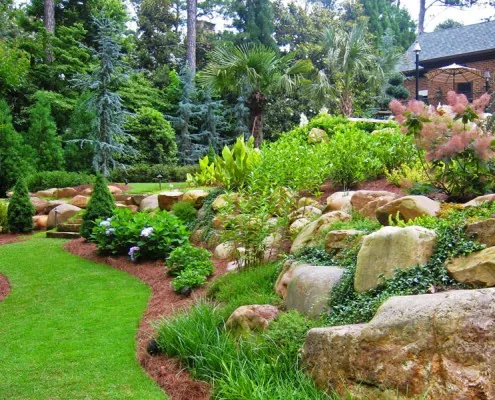
A smooth lawn meets a rougher, more varied garden at the foot of this planted bank. Large boulders form shelves and edges, with foliage growing between and around them. Solterra Landscape leaves the stones visible, making their weight and texture part of the garden rather than something to hide.
The lower edge is especially clear. A narrow, curving bed follows the lawn, while the ground rises behind it toward larger planting and the house. That distinction gives the slope an orderly foreground without asking every shrub above it to form a straight line.
Working at several scales
The boulders provide the largest texture close to the lawn. Smaller plants soften their joints, while taller growth carries the eye beyond the immediate edge. Large leaves, finer foliage and upright forms occupy different positions among the stones. Keeping those scales in view gives the bank depth; it does not read as one continuous green surface.
The stones also change the rhythm of the planting. Their broad faces interrupt the foliage, leaving small open intervals between the denser groups. From across the lawn, those pauses help individual parts of the garden remain recognizable.
Structure that lasts beyond the flowers
Solterra's design approach begins with the garden's winter form before adding seasonal interest. This view illustrates the relationship: stone, levels and larger plants establish the framework, while finer growth supplies changes in texture and color.
For a similar planted bank, the useful starting point is the view from its foot. The lower edge is the part encountered most closely, and a clear meeting with the lawn gives the rest of the slope room to be more varied. Here, the hard and soft elements remain visible together, each contributing something the other cannot.
At home
Vary the size and form of planting around substantial stones so the retaining work becomes part of the garden.