At a glance
- The work
- Patio, retaining edges and planting on a sloping narrow site
- The palette
- Pavers, masonry walls and planting
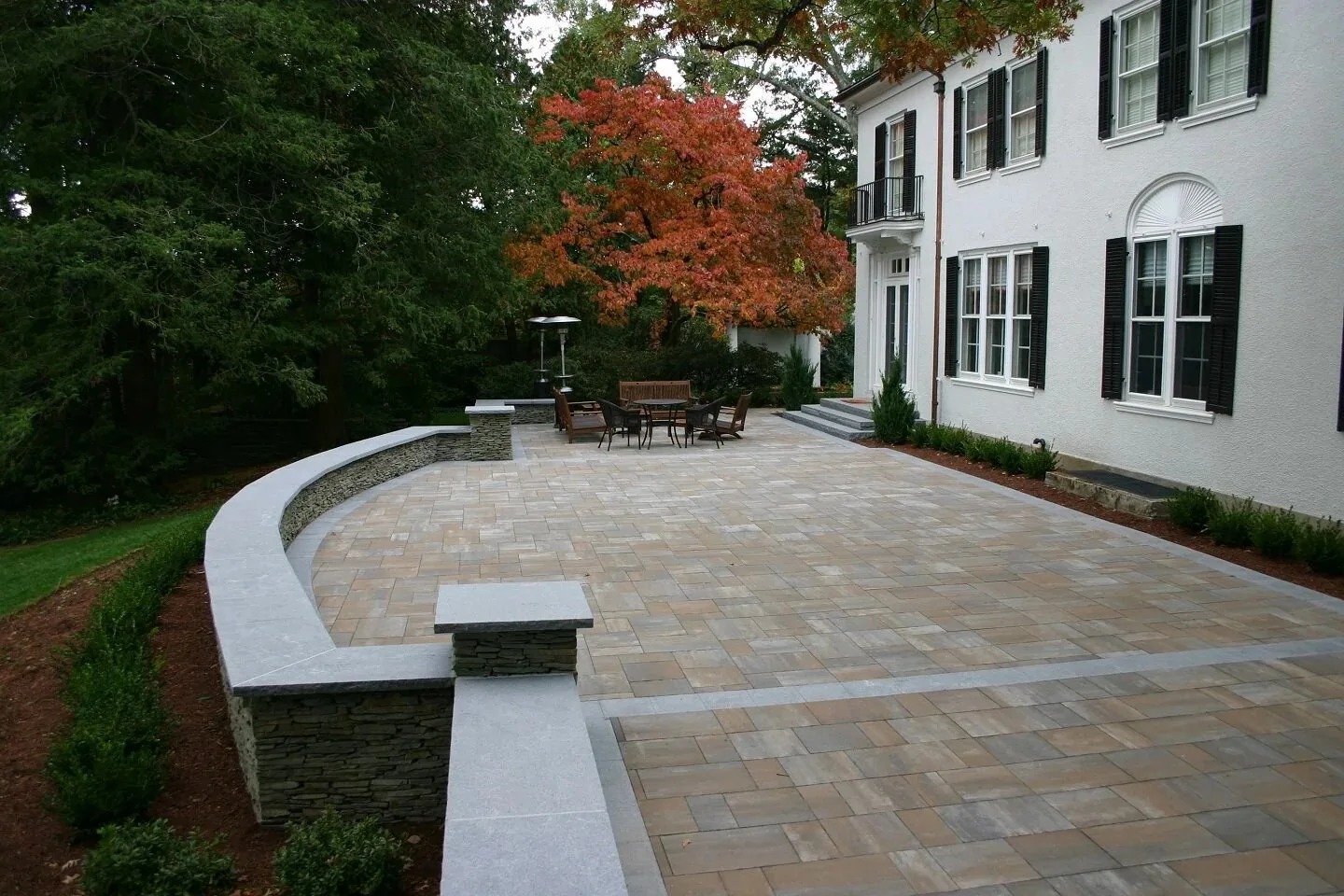
The patio follows a long curve away from the house. At one end, a smaller circular inset gives the paving a more intimate scale; along the outer edge, a low wall holds the larger terrace together. Rutland Nurseries calls the project Backyard Balance, an apt description of a narrow yard asked to provide generous gathering space.
The site had previously sloped. Working with the homeowner, the team carried the curved lines of the house into the landscape and created a broad patio with smaller coves attached to it. Planting at the edges provides separation from the surrounding ground.
A curve with a clear job
The wall is more than a decorative outline. In the photographs, it makes the terrace's usable area easy to read, giving a long space a settled perimeter. Its pale cap traces the curve while the paving inside remains a repeated geometric pattern.
That contrast prevents the shape from becoming visually restless. Most of the ground is straightforward and consistent; the edge does the turning. A band in the paving reinforces the transition between the main terrace and the smaller areas beside the house.
Leaving room for more than one gathering
The broad central area can accommodate a group, while the circular inset suggests a place for a smaller table or a few chairs. These are connected surfaces, so the garden does not need extra paths to link one activity to another.
The strongest idea is the relationship between the house and the outside edge. The patio does not simply repeat the building's footprint, nor does it impose an unrelated shape across the yard. It takes a line from the architecture and develops it into enough space for people to gather, with smaller moments along the way.
At home
A patio edge can respond to the house and the slope while still leaving room for distinct sitting areas.